Unified AI Reasoning over the Structured Data Stack
By: Adityanarayanan (Adit) Radhakrishnan
Founder of OuterProduct, MIT Faculty, Associate Member of the Broad Institute
Introduction
ChatGPT assists. Claude codes. The frontier AI labs came to prominence via different marketing strategies, but what they share is simple: these models are trained to operate on unstructured text data. They are both exceptional at parsing and reasoning over websites, contracts, documents, code, and more.
Yet, the majority of decision-critical data in enterprises is structured and tabular: transaction tables, customer records, clinical measurements, and more. Frontier AI models were not trained to reason over this structured data stack. Asking them to do so can lead to results that are hard to verify, feel incomplete, and are expensive to operationalize.
The frontier AI labs have fueled eagerness to adopt AI in the enterprise. Overcoming the performance gap in reasoning across the structured data stack is the key to accelerating enterprise AI adoption.
My co-founders and I brought to market the Unified Reasoning Engineᵀᴹ under the commercial name OuterProductᵀᴹ to unlock reasoning over structured data. Our mission is clear - provide AI agents the ability to reason, iterate and reliably execute actions across the structured data stack. To achieve this mission, we unified intelligence, interpretability, and verification with new methods for (1) reasoning over AI models; (2) verifying correctness of this reasoning; and (3) packaging this reasoning into context that agents can act on.
Why does deep-learning (the backbone of modern AI) work so well compared to classical machine learning models?
This question is one of the biggest questions in the field. Our breakthrough was discovering that deep networks were implicitly implementing a mathematical mechanism, the Average Gradient Outer Product (AGOP), to extract hidden patterns (features) from data. It turned out that none of the classical machine learning models had a similar mechanism for finding these features. As a result, they did not work as well as deep learning.
Following our discovery, my co-founders and I were excited about the promise of using the AGOP to build the next-generation of compute and data efficient AI models (which was a major focus of our previous work).
We only later realized that the real power of the AGOP was as an AI interpretability method. In fact, AGOP provides better interpretability than a number of the mechanistic interpretability tools available from large labs today, as shown in our second Science publication.
At OuterProduct, we have since expanded upon the AGOP to develop a suite of efficient and accurate algorithms for verifiable reasoning over models on structured data. These algorithms let us efficiently contextualize intelligence in a way agents can reliably act on. As a result, they make us uniquely positioned to fulfill our mission of building the Unified Reasoning Engine.
Taking a step back
The most successful applications of AI have been those where there is a way to reason over data. Take coding for example. Coding agents can reason over a codebase to figure out where to modify code and check whether their code is correct.
Today, structured data serves as the operational backbone for critical enterprise functions. Banks store enormous volumes of transaction data in rows and columns. Clinics store patient information. Retailers store product, supply chain and sales information.
AI should bring the same incredible transformation to these enterprise domains as it brought to coding.
The fundamental challenge lies in enabling reasoning over the enterprise structured data stack.
Enterprise structured data resides across disparate applications and systems of record. Moreover, these systems often contain outputs of many black-box Machine Learning (ML) models (for example, transaction data may be enriched with risk scores from fraud detection models).
The past decade has given us a stack that consolidates structured data into a central source of truth for intelligence like analytics agents and ML models. The AI transformation of the future will be brought forth by defining and implementing reasoning across this stack.
We founded OuterProduct with the belief that AI needs comprehensive reasoning over structured data to be productive. Our vision unifies intelligence, interpretability, and verification to give agents the reasoning power to execute enterprise tasks.
The current state of structured data intelligence
Today, intelligence on structured data is accessible via two avenues:
Text-to-SQL analytics agents that take user prompts and use SQL or BI to source context to answer user questions; and
ML models on structured data (like tabular, relational, and time-series foundation models) that are used for predictive modeling (regression and classification).
Neither provides sufficient reasoning context for agents to execute decisions.
For example, analytics agents help analysts surface historical insights from data. Yet, analysts still need to do a massive amount of work to synthesize these insights into actionable, trustable recommendations that they can implement to optimize their business.
Similarly, ML models are powering business decisioning and optimization. Yet, they are often black-box, making them difficult to trust blindly without additional context.
The future of structured data intelligence with unified reasoning
To elevate intelligence to reasoning context for agents, we need to integrate intelligence with two key components: interpretability (to contextualize outputs of ML models) and verification (to check that reasoning is correct). The Unified Reasoning Engine enables this integration.
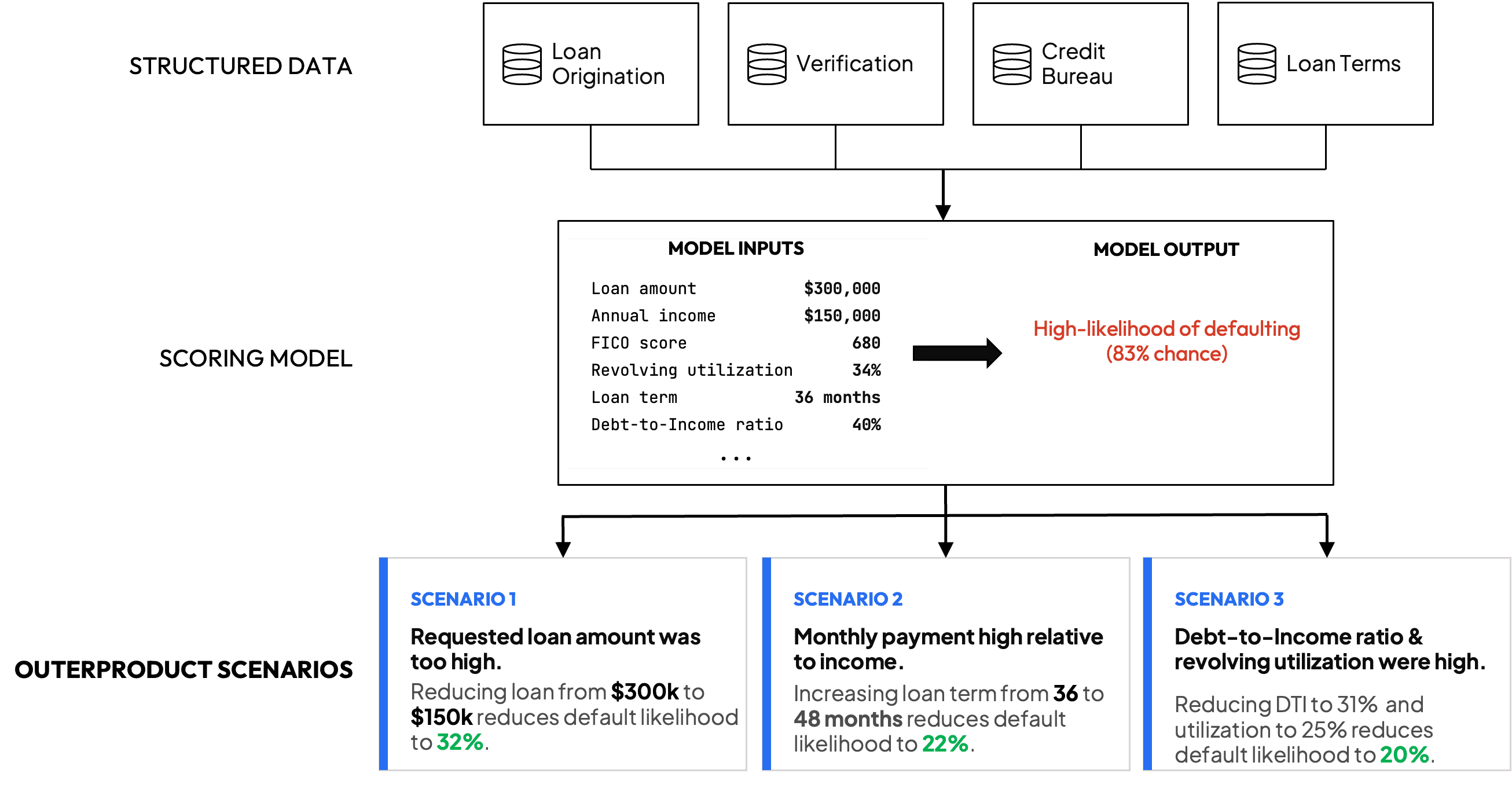
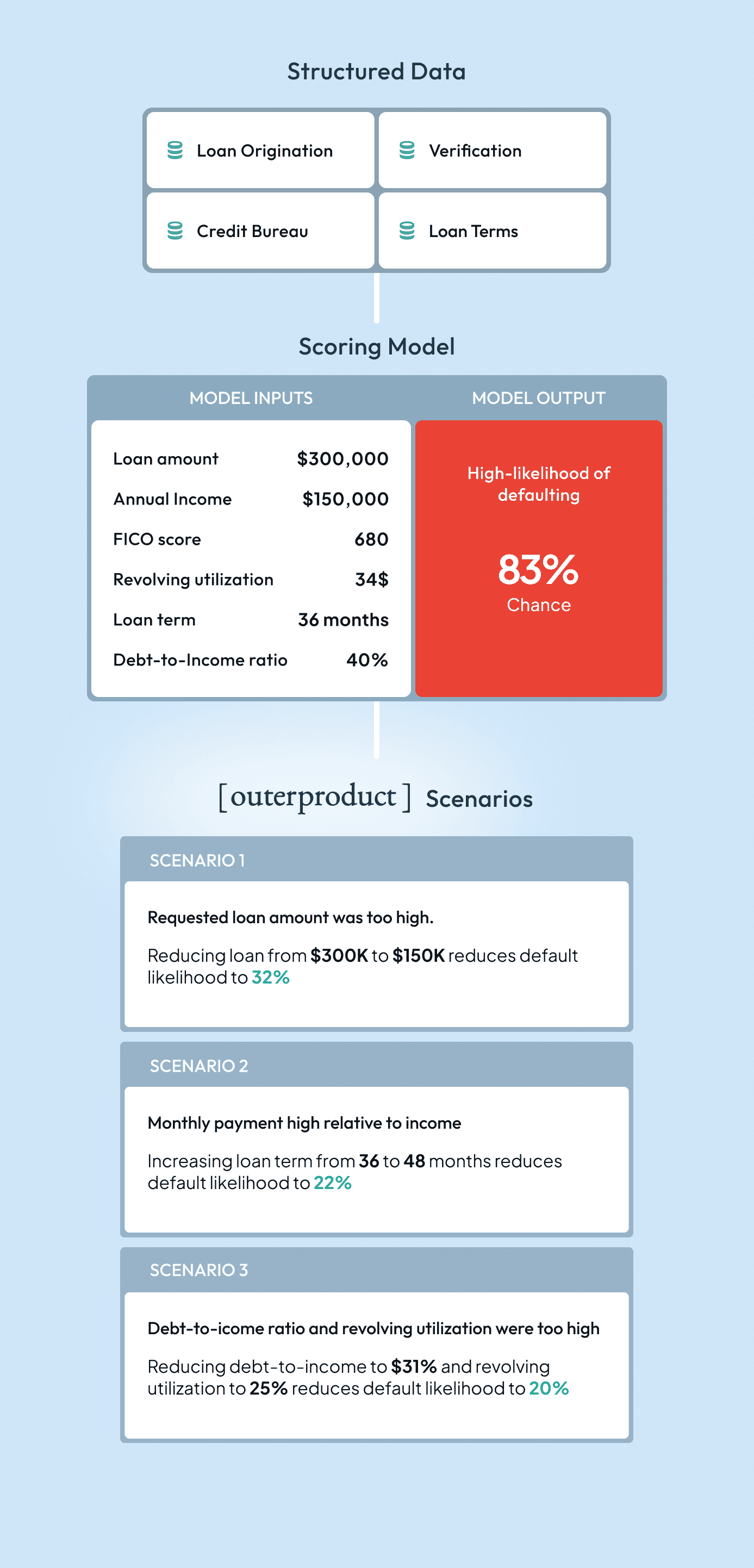
As a concrete example, let’s walk through the difference the Unified Reasoning Engine can make in credit decisioning (the process through which a lender decides to approve someone for a loan).
With only an agent operating on structured data, a team of analysts can readily pull historical information about their credit decisioning process. Yet, they still have to look through and manually discover, test, and implement new strategies for improving their product.
With only an ML model for approval, a team of analysts can readily set approval thresholds to automate decisioning. Yet, they still have to figure out what is driving these model outputs, whether the model is discriminatory, and what they can do to improve overall decisioning accuracy.
With a unified reasoning engine, agents can reason over the structured data ecosystem to (1) automatically surface data-driven, backtested recommendations for improving decisioning; (2) adaptively improve and build ML models based on decisioning trends; (3) Make sure model-guided decisioning is non-discriminatory and compliant with the company and regulatory guidelines.
The path ahead
The data processing revolution of the past decade was largely focused on centralization of enterprise structured data.
The current wave of AI on enterprise structured data is fractured across two fronts (1) analytics agents to help streamline data access for insight generation; (2) and ML models used for predictive analytics (including tabular foundation models, like TabPFN from PriorLabs and Nexus from Fundamental, relational foundation models like KumoRFM from Kumo, etc.).
The AI transformation of the future will come from integrating intelligence with interpretability and verification to enable unified reasoning over the entire structured data stack. Unified reasoning brings the next-generation of business value: It enables continuous, adaptive optimization of business processes while maintaining trustworthiness and compliance with enterprise specifications and values.
OuterProduct is building this Unified Reasoning Engine, and it is needed as a core part of the structured data stack across finance, insurance, retail, healthcare, and more. Our vision is now realizable because of our new reasoning algorithms to bridge the latest in agentic AI (from Anthropic, OpenAI, and other providers) with the latest in modeling and data processing. The Unified Reasoning Engine is key to turning structured data into verifiable reasoning context for the next generation of enterprise AI.
