The Reasoning Bottleneck for Agentic AI in Financial Services
Agents can't scale in regulated decisioning without reasoning over predictive systems.

OuterProduct Labs
Introduction
Agentic AI is the dominant focus for driving productivity in every industry, but the scope of the conversation is too narrow.
In Financial Services, predictive models serves as the backbone powering many critical functions. Underwriting, fraud, risk, product recommendations, and regulatory compliance all require predictive models to make decisions from data, at scale.
This fundamental dependency on predictive models won’t disappear as AI agents get layered on top of business processes. Agentic customer experiences, compliance automation, and augmented human-in-the-loop processes will continue to sit downstream of predictions and scores from operational predictive systems. In many cases, as agents become active participants in these processes, those systems become more load-bearing, not less.
For AI agents to be effective, they need to reason over the predictive systems beneath the process they’re orchestrating. Given the black-box nature of how predictive models make decisions, this represents a significant challenge.
An obvious candidate to address this contextual reasoning gap is the Machine Learning (ML) Explainability toolset. In practice, legacy explainability frameworks (like SHAP) don’t support the depth of context to ground agents in the logic for how and why predictive models made decisions. These frameworks are ‘good enough’ for post-hoc regulatory compliance checkboxes, and not much else.
Agents need as much context as possible; the specific conditions behind every predictive model decision delivered as live context that they can reason over to act. That gap is the reasoning bottleneck between Predictive Models and Agentic AI. It sets the ceiling on the extent to which underwriting, fraud, or customer-facing experiences can be effectively automated.
Purpose-built to solve this problem, OuterProduct powers AI Apps that reason across your existing operational predictive models in real-time to elevate 'black-box' decisions to agentic intelligence.
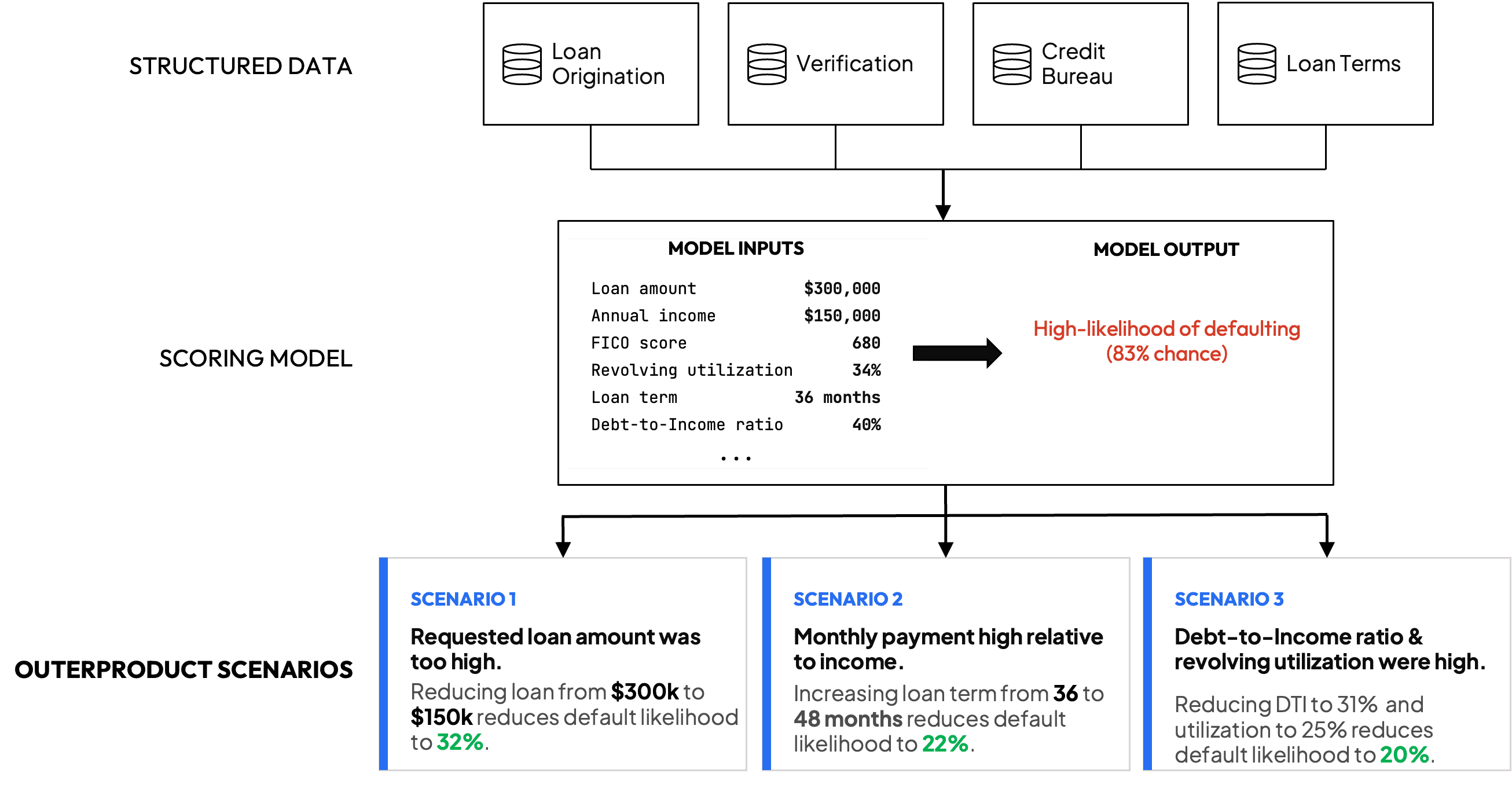
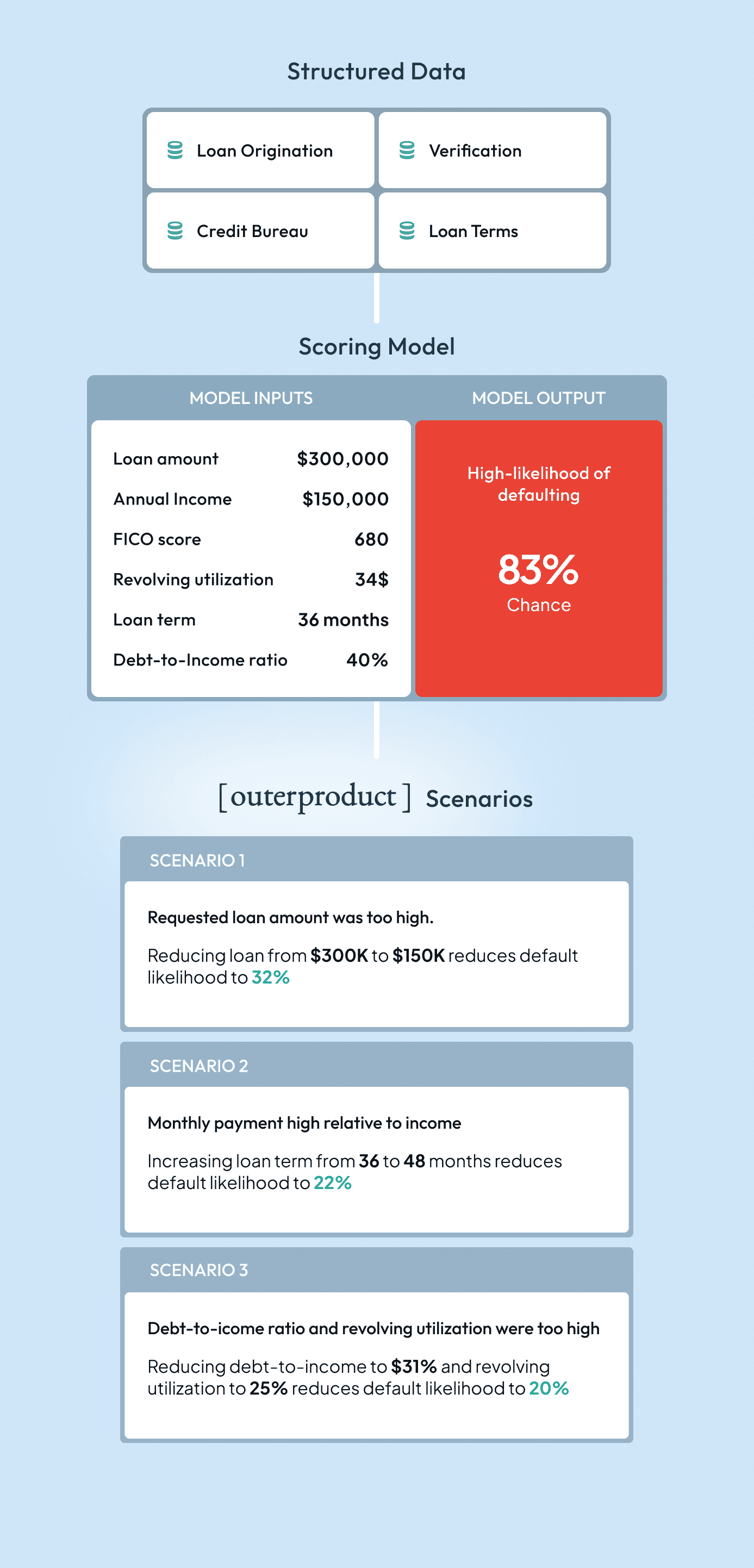
Introducing OuterProduct: AI Apps that reason over the real-time context from predictive model decisions
OuterProduct fundamentally changes how AI agents reason over the predictive model decisions to power AI apps.
Built on foundational AI research (2x published in Science), OuterProduct reasoning agents produce the drivers, conditions, and counterfactual scenarios behind every predictive model decision, in real time, across your existing operational models.
Attribution accurate at the individual decision level
OuterProduct identifies the drivers of individual model predictions with 5x the accuracy of legacy Explainable AI on benchmarks that mirror real-world financial services portfolios.
Context delivered at inference
Explanations run at the speed of predictive model decisioning, in the decision context window rather than behind it, so agents can reason and act in real-time.
Counterfactual narrative for every decision
Deterministic counterfactuals tell you not just what influenced a score, but what would change it. These counterfactuals provide additional context for adverse action remediation, counteroffers, and appeals.
Bridging the ML reasoning gap, OuterProduct empowers a class of AI Apps that innovate with LLMs for automation and customer experience on top of the classical predictive systems that already drive the decisions, keeping every outcome traceable to a defensible rationale.
Risk and Compliance can automatically optimize models and deploy apps, producing evidence-based fair lending proofs in real-time.
Fraud leaders can deploy reasoning agents that diagnose specific intent behind high-risk alerts.
Underwriting and Product leaders can deploy customer-facing agents that personalize adverse action notices or assist applicants with intelligent counterfactuals to boost approval rates.
Contact us if you are interested in deploying the next-generation of real-time AI apps capable of reasoning across your operational models.
